
Australia's First Chinese Restaurant: From Gold Rush Cookhouse to Modern Commercial Kitchens
https://uploads.prod01.sydney.platformos.com/instances/647/assets/modules/homepage/webapp_uploads/blog/images/sck-firstchineserestaurant-11789454282973-1789454283869.png?updated=1789454290&updated=1789454290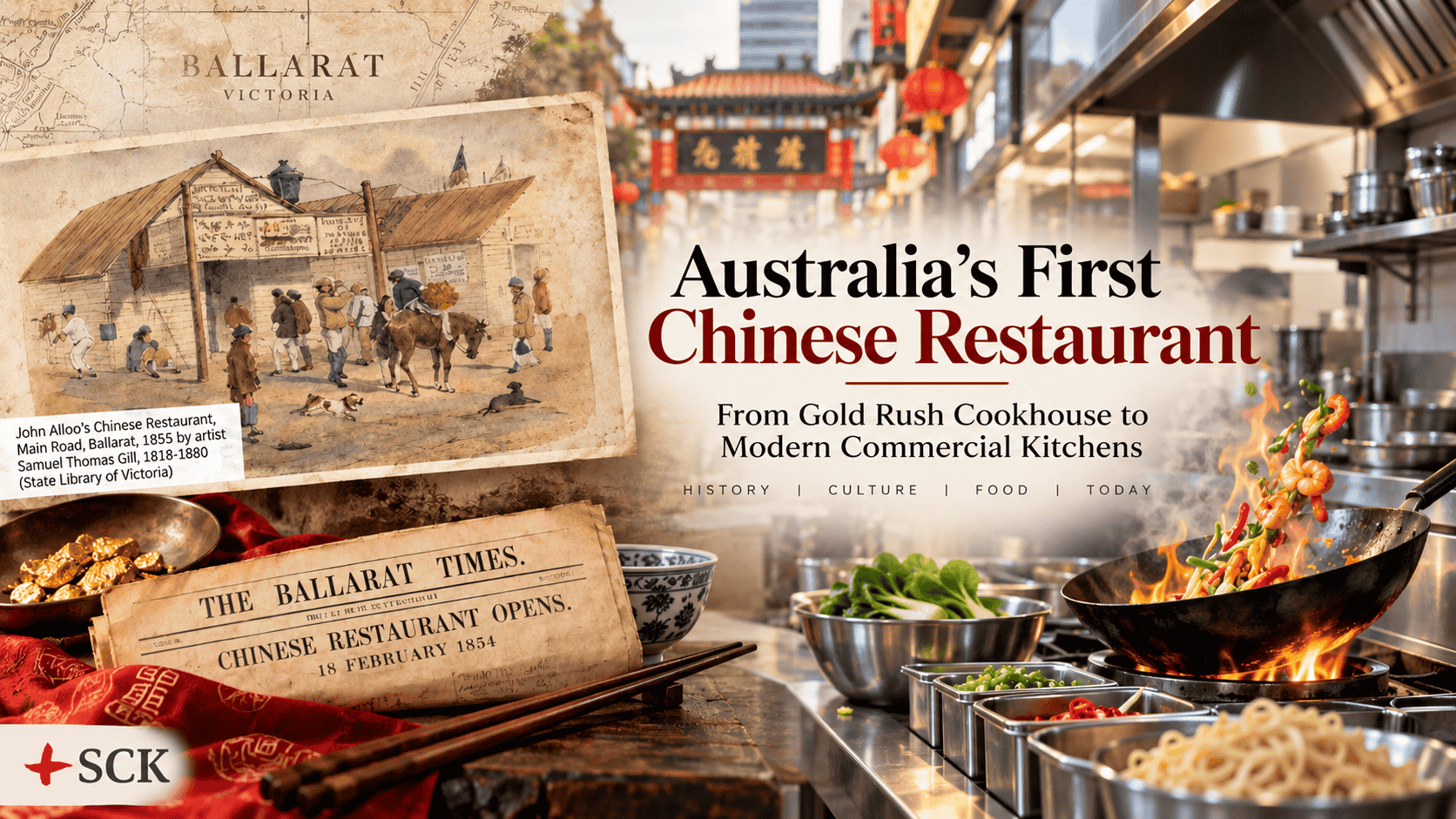
Australia's First Chinese Restaurant: From Gold Rush Cookhouse to Modern Commercial Kitchens
Chinese restaurants are now such a familiar part of Australia's hospitality landscape that it is difficult to imagine our towns and cities without them. From neighbourhood takeaway shops and regional Chinese restaurants to bustling Chinatown dining rooms and contemporary Asian venues, Chinese cuisine has become deeply woven into Australian food culture.
But where did the story begin?
One of the earliest documented Chinese restaurants in Australia dates back to 1854, during the Victorian gold rush. Its proprietor was John Alloo, a Chinese immigrant whose restaurant served hungry miners on the Ballarat goldfields.
More than 170 years later, the commercial kitchen behind a Chinese restaurant looks very different. High-powered wok cooking, specialised steamers, noodle cookers, refrigeration, commercial dishwashers and purpose-designed ventilation can now support hundreds of meals during a busy service.
The equipment has changed dramatically, but the connection between Chinese cooking and Australian hospitality has a remarkably long history.
Who Opened Australia's First Chinese Restaurant?
John Alloo, originally known as Chin Thum Lok, was born in Guangdong, then commonly referred to as Canton. He arrived in Australia during the 1840s, before the major gold rushes transformed the colonies.
In 1854, Alloo opened what is generally regarded as Australia's first documented Chinese restaurant, at Bakery Hill on the Ballarat goldfields in Victoria. Chinese-operated cookshops probably existed before this, so describing Alloo's establishment as the first documented Chinese restaurant is more historically accurate than claiming it was unquestionably the first.
Its location made good commercial sense.
Ballarat was experiencing extraordinary growth as people arrived in search of gold. Thousands of miners and workers needed somewhere to eat, creating opportunities for cooks, shopkeepers, growers and other businesses.
Alloo's restaurant was positioned on the Eureka Lead, one of the area's important gold-mining locations. It catered to the miners working nearby and was eventually relocated to Main Road in Ballarat.
The Menu May Surprise You
Anyone imagining bowls of noodles, dumplings and wok-fried dishes might be surprised by what Alloo was serving.
His establishment offered largely European-style food.
Historical accounts describe a menu that included soups, roasted and boiled meats, vegetables, plum puddings and jam tarts. The restaurant even advertised that soups were always available.
This tells us something important about restaurant operation that remains relevant today: successful hospitality businesses adapt to their customers.
Alloo was operating on an Australian goldfield and feeding a diverse population of miners. His restaurant therefore wasn't simply recreating a dining experience from China. It was responding to what its local market wanted and what ingredients and cooking practices made sense at the time.
Modern restaurants continue to make the same calculation, although today's operators have vastly greater access to ingredients, specialised equipment and different regional Chinese cooking traditions.
Chinese Migration and Australia's Gold Rush
Alloo's story was part of a much larger period of Chinese migration.
Gold discoveries attracted people from around the world to Australia during the 1850s. Chinese migration increased dramatically, with the National Museum of Australia recording 12,396 Chinese arrivals in 1856 alone. By 1861, 38,258 Australian residents had been born in China.
More than 24,000 Chinese immigrants were living on Victorian goldfields including Ballarat, Bendigo, Beechworth, Castlemaine, Ararat and Maryborough in 1861. Thousands more were working on goldfields throughout New South Wales.
Not everyone remained a miner.
Chinese migrants became merchants, cooks, market gardeners and small-business operators. Chinese-run cookshops helped feed goldfield communities, while market gardeners supplied fresh produce to Australia's growing towns and cities.
Hospitality therefore became one of several important ways Chinese Australians contributed to Australia's developing food culture.
From Goldfield Cookshops to Australian Chinese Restaurants
As the gold rushes declined, Chinese communities became established in Australian cities and regional centres.
Restaurants and food businesses followed.
Sydney and Melbourne developed Chinatown districts where restaurants became part of the surrounding commercial communities. Chinese restaurants also appeared throughout regional Australia, sometimes offering Chinese dishes alongside food designed for predominantly European Australian customers.
Over subsequent generations, Chinese food became increasingly familiar to Australian diners.
By the 1890s, Chinese cooks were already a significant part of the country's food industry. ABC Education reports that around one in three cooks in Australia was Chinese during the 1890s.
Chinese cuisine continued to evolve alongside Australian tastes. What Australians understood as a "Chinese restaurant" also broadened considerably as migration patterns changed and diners gained exposure to different regional cuisines and cooking techniques.
Today, the category can encompass everything from traditional Cantonese restaurants and yum cha venues to Sichuan dining, dumpling restaurants, noodle houses, barbecue shops, takeaway businesses and modern Asian-fusion kitchens.
And that diversity has major implications for commercial kitchen design.
What Does a Modern Chinese Restaurant Kitchen Need?
There is no universal equipment list for a Chinese restaurant.
A small dumpling shop has very different production requirements from a 200-seat yum cha restaurant. A noodle venue will have different priorities again, while a high-volume wok kitchen requires serious consideration of heat, gas supply, extraction and workflow.
However, several equipment categories commonly form the backbone of modern Chinese and Asian commercial kitchens.
Commercial Woks and Wok Burners
For many Chinese restaurants, the wok station is the centre of production.
Commercial wok cooking is designed around intense heat and rapid cooking. Unlike a standard domestic cooktop, a purpose-built commercial wok range can support the speed and heat recovery required when chefs are preparing dishes continuously throughout service.
Depending on the menu and kitchen configuration, operators may consider single, double or multi-hole wok arrangements.
Waterless wok technology has also become an important consideration in modern commercial kitchens. Traditional wok stations can consume substantial amounts of water for cooling and cleaning. Waterless designs can reduce unnecessary water consumption while maintaining a practical workstation for the chef.
Choosing a wok system shouldn't be based on burner power alone. Available utilities, kitchen dimensions, menu volume, chef preference, ventilation requirements and cleaning access should all form part of the decision.
Noodle Cookers
Noodles are another high-volume component of many Asian menus.
A commercial noodle cooker gives chefs dedicated baskets and controlled boiling capacity so multiple portions can be prepared simultaneously.
That can be particularly useful for restaurants producing noodle soups, wonton noodles, ramen-style dishes or other menu items where noodles need to move rapidly from cooking to plating.
In a busy venue, separating noodle production from general boiling tasks can also improve workflow and reduce competition for stovetop space.
Commercial Steamers
Steaming has been central to Chinese cooking for generations, but modern commercial kitchens can perform it on a much larger scale.
Dim sum restaurants in particular may need significant steaming capacity for dumplings, buns and other dishes.
Commercial steamers allow operators to increase production while maintaining more predictable cooking conditions. Depending on the menu, equipment might include dedicated dim sum steamers, steaming cabinets or multifunction cooking equipment capable of controlled steaming.
Capacity should be considered carefully. Buying too small can create a production bottleneck at peak service, while excessive capacity occupies valuable kitchen space and adds unnecessary capital cost.
Rice Cookers
Rice may appear simple, but producing it consistently in commercial quantities is very different from preparing a few portions at home.
A commercial rice cooker can free chefs from repeatedly monitoring pots while producing consistent batches throughout service.
When selecting capacity, operators should consider more than the number of seats in the restaurant. Takeaway volume, delivery orders, peak trading periods and the number of rice-based dishes on the menu can substantially increase demand.
Chinese Barbecue and Duck Ovens
Restaurants specialising in roast duck, char siu and other Chinese barbecue products may require dedicated roasting equipment.
Commercial duck ovens and related roasting equipment are designed around these specialist production requirements.
Because these appliances can involve substantial heat and specialised installation conditions, their location should be planned as part of the kitchen design rather than treated as an appliance that can simply be added later.
Refrigeration and Food Preparation
The dramatic cooking equipment often gets the attention, but refrigeration can be just as important to a productive Chinese commercial kitchen.
Busy restaurants may work with fresh vegetables, seafood, poultry, meat, sauces, prepared ingredients and large quantities of mise en place.
Commercial upright refrigerators provide bulk storage, while refrigerated preparation counters and underbench units can keep frequently used ingredients closer to production stations.
The objective is not simply to maximise refrigeration capacity. Good design reduces unnecessary movement.
If a wok chef repeatedly walks across the kitchen for ingredients during a busy service, the layout is working against the team.
Strategically positioned refrigeration can help create faster and more logical production zones.
Commercial Dishwashers
High-volume food production creates high-volume washing.
A smaller restaurant may be adequately served by an undercounter commercial dishwasher, while a busy restaurant with large numbers of plates, bowls and utensils may benefit from a passthrough dishwasher.
Very high-volume operations can require even greater washing capacity.
The correct machine depends on peak demand rather than simply the restaurant's total number of seats.
Operators should consider how quickly clean crockery needs to return to service, available space, water and electrical connections, washroom workflow and staffing.
Exhaust and Ventilation
Ventilation deserves particular attention in a wok-based kitchen.
High-powered cooking can generate significant heat, steam, grease and cooking fumes. The exhaust system therefore needs to be considered alongside the cooking equipment from the beginning of a project.
Simply installing powerful cooking appliances beneath an unsuitable canopy can create an uncomfortable and potentially problematic working environment.
Equipment selection, exhaust capacity, make-up air, kitchen layout and applicable Australian requirements should be considered together with suitably qualified designers and trades.
This is especially important when replacing conventional cooking equipment with higher-output appliances or converting an existing tenancy into a Chinese restaurant.
Kitchen Workflow Matters as Much as Equipment
Buying good commercial kitchen equipment does not automatically create an efficient kitchen.
How the equipment works together matters.
Think about the path food follows:
delivery → storage → preparation → cooking → plating → service → warewashing
Ideally, those stages should flow logically without staff constantly crossing each other's paths.
A wok chef needs rapid access to prepared ingredients. The preparation team needs sufficient bench space and refrigeration. Finished dishes need a clear path to the pass. Dirty plates should be able to reach the wash area without travelling back through food preparation zones.
In compact takeaway kitchens, every metre matters.
In larger restaurants, poorly planned distances can become equally expensive because staff repeat those unnecessary movements hundreds of times during a service.
This is why equipment selection should ideally happen as part of the overall commercial kitchen planning process rather than appliance by appliance.
Energy, Water and Running Costs
John Alloo probably didn't need to worry about electricity tariffs or the efficiency rating of a commercial dishwasher.
Today's restaurant operator certainly does.
Purchase price remains important, but it is only one part of the cost of owning commercial kitchen equipment.
Gas, electricity and water consumption can continue for years after the equipment has been purchased. Labour requirements, cleaning time, servicing, spare parts availability and equipment downtime also influence the real cost of operation.
For example, a cheaper appliance that slows production or frequently requires repair may ultimately cost more than a higher-quality machine that performs reliably during every service.
Waterless wok systems, efficient commercial dishwashers, modern refrigeration and correctly sized cooking equipment can all contribute to reducing unnecessary operating costs.
The goal isn't necessarily to buy the most expensive equipment.
It is to select equipment that suits the restaurant's actual production requirements.
Planning Equipment Around the Menu
Before comparing brands or models, start with the menu.
Ask:
- Which dishes will sell in the greatest numbers?
- What needs to be cooked simultaneously during peak service?
- Which processes require specialist equipment?
- How much refrigerated and frozen storage is required?
- What equipment would create a bottleneck if it failed or became overloaded?
A dumpling-focused restaurant may prioritise steaming and preparation capacity. A Cantonese barbecue operation could place roasting and refrigeration higher on the list. A busy takeaway might prioritise multiple wok stations, fast refrigeration access and efficient packaging workflow.
Equipment should support the food being produced, rather than forcing chefs to adapt the menu around an unsuitable kitchen.
From John Alloo's Restaurant to Today's Commercial Kitchen
The contrast between John Alloo's small Ballarat establishment in 1854 and today's sophisticated Chinese commercial kitchens is enormous.
Yet there is an interesting similarity.
Both were designed to feed customers efficiently in the hospitality environment of their time.
Alloo adapted his offering to the miners of the Victorian goldfields. Today's restaurant operators face different pressures: rising operating costs, labour challenges, takeaway and delivery demand, food safety requirements, faster service expectations and increasingly sophisticated customers.
The technology has changed.
The fundamental hospitality challenge hasn't.
A successful kitchen still needs to produce the right food, consistently and efficiently, for the customers it serves.
Frequently Asked Questions
What was the first Chinese restaurant in Australia?
John Alloo's restaurant in Ballarat, Victoria, opened in 1854 and is generally recognised as Australia's first documented Chinese restaurant. Earlier Chinese cookshops may have operated before it.
Where was Australia's first Chinese restaurant?
John Alloo's restaurant was originally located at Bakery Hill on the Ballarat goldfields and later relocated to Main Road, Ballarat. A reproduction based on an S.T. Gill depiction can be found at Sovereign Hill.
Did Australia's first Chinese restaurant serve Chinese food?
Interestingly, John Alloo's restaurant largely catered to the tastes of local miners and served European-style dishes including soups, meats, vegetables and desserts.
What equipment does a Chinese restaurant kitchen need?
It depends on the menu, but common equipment can include commercial wok burners, noodle cookers, steamers, rice cookers, refrigeration, preparation equipment and commercial dishwashers. Restaurants specialising in particular dishes may also require equipment such as duck ovens or dedicated dim sum steamers.
What type of wok is used in Chinese restaurants?
Professional restaurants generally use commercial wok cooking stations designed for rapid, high-output cooking. The appropriate configuration depends on menu volume, chef preference, available gas or energy supply, ventilation and kitchen design.
Why is ventilation important in a Chinese commercial kitchen?
High-output wok and other cooking equipment can produce considerable heat, grease, steam and fumes. Appropriate commercial extraction and make-up air are therefore important parts of the overall kitchen design and should be assessed against the equipment being installed and applicable requirements.
How do I choose commercial equipment for a Chinese restaurant?
Start with the menu, expected peak production, available space and utilities. Then consider workflow, equipment capacity, energy and water consumption, cleaning, servicing and future growth. The best equipment is not necessarily the largest or most expensive. It is equipment properly matched to how the kitchen operates.
Building the Next Generation of Australian Chinese Kitchens
From an 1854 goldfields cookhouse to today's high-volume restaurant kitchen, the story of Chinese hospitality in Australia is one of adaptation.
For operators planning a new Chinese restaurant, takeaway or Asian commercial kitchen, understanding the menu and workflow should come before choosing individual appliances.
Sydney Commercial Kitchens works with hospitality businesses to source commercial cooking, refrigeration, food preparation and warewashing equipment suited to real operational requirements. SCK also offers a range of Asian cooking equipment for Chinese commercial kitchens, including commercial wok cookers, noodle cookers, rice cookers, steamers and other specialised equipment designed for busy restaurant production.
More than 170 years after John Alloo began serving miners in Ballarat, the equipment may be almost unrecognisable, but getting the kitchen right remains at the heart of a successful restaurant.
Historical image and original story source: Australian Food Timeline.
Make your business our next satisfied client
If you are looking to buy equipment for your cafe or restaurant at the best price, then let us do the hard work and source the right product for your restaurant, cafe, takeaway or commercial kitchen.
Our goal at SCK is to sell you products that add value to your business.
We power your kitchen!
Sydney Commercial Kitchenshttps://uploads.prod01.sydney.platformos.com/instances/647/assets/modules/homepage/images/sck.svg?updated=1789454290