
From Health Inspector Anxiety to HACCP Confidence
https://uploads.prod01.sydney.platformos.com/instances/647/assets/modules/homepage/webapp_uploads/blog/images/from-health-inspector-anxiety-to-haccp-confidence19201763634090929-1763634092772.jpg?updated=1789454290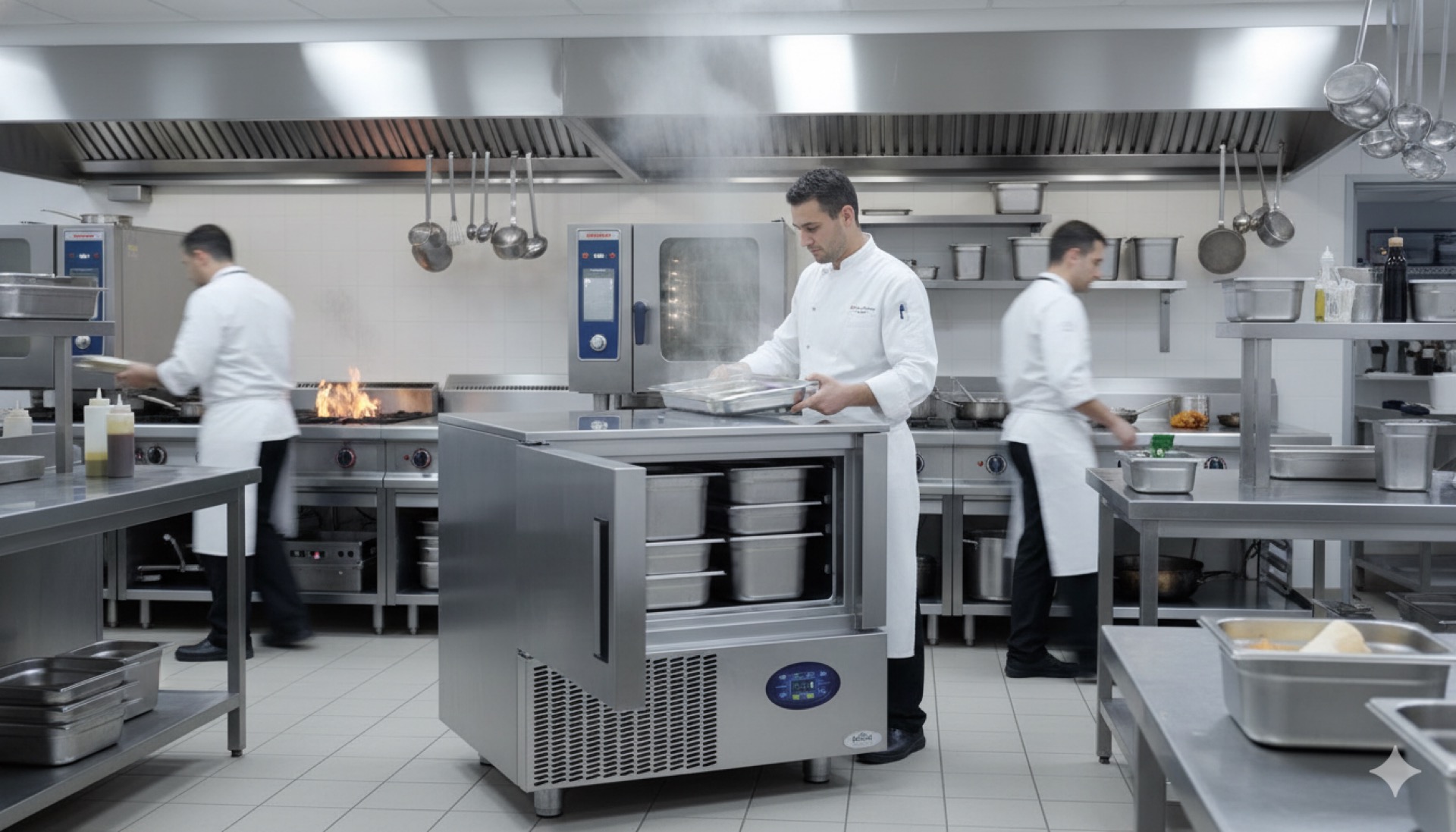
From Health Inspector Anxiety to HACCP Confidence: How Starry Nights Restaurant Transformed Food Safety with a Blast Chiller
Elena Starr stood in her Starry Nights Restaurant's kitchen at 11 PM, watching her sous chef frantically portion tomorrow's chicken stock into shallow containers. Again. The same nightly routine that had become an exhausting dance with food safety regulations—and her restaurant's reputation.
The Problem Nobody Talks About: HACCP Compliance is Breaking Busy Kitchens
Elena runs Starry Nights Restaurant, a celebrated modern Australian restaurant in Woolloomooloo with harbour views that draws crowds seven nights a week. Her menu - featuring house-made terrines, slow-cooked proteins, and delicate seafood preparations—has earned her loyal customers and glowing reviews. But behind the success, a silent problem was creating daily operational chaos.
The temperature danger zone. Every chef knows it: 5°C to 60°C, where bacteria multiply at terrifying speed. HACCP regulations require cooked food to be cooled from 60°C to 21°C within 2 hours, then to 5°C within another 4 hours. Sounds simple on paper. In a busy commercial kitchen? Nearly impossible without the right equipment.
Elena's reality looked like this: Batch-cooking pulled pork for tomorrow's lunch service meant finishing at 10 PM, then waiting hours for it to cool safely. Stock that needed to reach room temperature before refrigeration meant shallow pans covering every spare surface. Desserts for weekend service? Made Thursday because cooling took so long. One prep cook dedicated just to managing the cooling process—stirring, monitoring, transferring, checking temperatures every 30 minutes with a probe thermometer.
The inefficiency was crushing, but the risk was worse. One failed temperature check, one bacterial bloom in a batch of cooling protein, one health inspector visit during the wrong moment—any of these could destroy everything she'd built.
"I'd wake up at 3 AM thinking about food safety," Elena recalls. "We were doing everything by the book, but the book assumes you have time nobody actually has during service. Every night felt like we were gambling with our reputation."
The Cost of Playing it Safe (The Expensive Way)
But Elena wasn't just losing sleep. She was losing money.
The hours spent managing cooling meant her prep team couldn't focus on actual prep work. Labour costs for late-night cooling supervision were adding $800-$1,200 per week—$52,000 annually, just to meet minimum safety standards. Food waste from batches that didn't cool properly: another $400-$600 per week. The opportunity cost? Enormous. Weekend specials had to be prepped on Thursday because Friday cooling wouldn't finish in time, limiting menu flexibility and forcing larger-batch cooking that often resulted in waste.
Then there were the limitations nobody calculated in dollars, but everyone felt in stress. Elena couldn't expand her popular terrine selection because the cooling space was maxed out. Catering opportunities—lucrative ones—were declined because she couldn't guarantee proper cooling for off-site prep. Her talented team was spending skilled labour time babysitting thermometers instead of doing creative cooking.
The breaking point came during a hectic Saturday service. A health inspector arrived unannounced during afternoon prep. Elena watched his expression change as he observed her cooling setup: shallow pans everywhere, timers going off, staff juggling temperature checks between actual prep work. She passed the inspection—barely—but the inspector's parting words haunted her: "You're technically compliant, but you're making this harder than it needs to be. There are better systems."
He was right. Her competitors were adapting faster, offering more complex preparations without the cooling chaos. The gap was widening every week.
The Conversation That Changed Everything
Three days after that inspection, Elena called Sydney Commercial Kitchens. The conversation started simply: "I need to meet HACCP requirements without dedicating half my team to thermometer duty."
The SCK team asked an unexpected question: "What if you could take anything from 90°C to 3°C in 90 minutes—safely, consistently, automatically?"
Elena was sceptical. She'd heard about blast chillers but assumed they were only for large hotels or industrial kitchens. "Surely that's overkill for a 60-seat restaurant?"
Then came the reality check that shifted her thinking: "You're currently spending $52,000 per year in labor just managing cooling, plus food waste costs. A blast chiller isn't overkill—it's efficiency. It's insurance. And here's what you're not calculating: the menu opportunities you're missing because you can't cool fast enough."
The Everlasting BCE5010 Blast Chiller Freezer solved the specific problems Elena faced:
This isn't just a powerful refrigeration unit—it's a precision food safety system designed for exactly her operational reality. The Everlasting BCE5010 Blast Chiller Freezer rapidly reduces food temperature with controlled, powerful cooling, bringing cooked food through the danger zone in a fraction of the time it takes traditional cooling.
How it works: Food goes in at service temperature. Set the cycle—blast chill or blast freeze. Walk away. The unit's intelligent control system monitors and automatically adjusts airflow and temperature, bringing food to safe temperatures in 90 minutes or less. No thermometer checks every 30 minutes. No shallow pans taking up half the kitchen. No overnight cooling supervision.
The capacity handled by Starry Nights Restaurant's volume perfectly: 50kg blast chill capacity, 35kg blast freeze. Large enough for their busiest prep days, compact enough not to dominate the kitchen. Heavy-duty stainless steel construction, digital control panel, and automatic defrost system. This was commercial-grade equipment built for daily punishment.
But what sealed Elena's decision were three specific advantages:
- HACCP compliance became automatic. The digital system tracks and records temperature progression, creating documentation that health inspectors want to see. No more manual logs, no more "did someone check this?" stress.
- Time compression was dramatic. What traditionally took 6-8 hours now takes 90 minutes. Did that chicken stock finish at 11 PM? Ready for storage by 12:30 AM. Prep teams finishing at reasonable hours instead of midnight.
- Menu flexibility opened up. Suddenly, same-day prep became possible. Complex preparations that required advance planning could be executed on the morning of. Catering opportunities became viable.
The ROI calculation was compelling: equipment investment versus annual cooling labour costs, plus food waste reduction, plus new revenue opportunities. Payback period estimated at 14-16 months, with compounding benefits continuing for years.
The Transformation: From Cooling Chaos to Confidence
Installation took one afternoon during Starry Nights Restaurant's Tuesday closure. The SCK team placed the BCE5010 in Elena's prep area, where it was accessible without disrupting workflow. Staff training took 30 minutes—the system was that intuitive.
The difference showed up immediately.
Tuesday night prep was revelatory. Elena's team cooked a large batch of slow-braised beef for Thursday's menu. Previously, this meant shallow pans, overnight cooling, and Wednesday morning transfer. With the blast chiller? Finished at 9:30 PM, portioned into containers, and into the BCE5010 by 9:45 PM. Safe storage temperature by 11:15 PM. Everyone is home before midnight.
Wednesday morning, Elena tested it with her signature duck terrine—a preparation she'd been scaling back because cooling logistics were nightmarish. Made at 10 AM. Blast chilled by noon. Ready for service that evening. The preparation that previously required 48-hour advance planning now fits into a single shift.
But the real transformation emerged over the following months:
Three months after installation, Starry Nights Restaurant's kitchen had undergone a fundamental change.
The operational impact:
- Prep efficiency up 40% – Teams finishing prep in regular hours, focusing on cooking instead of cooling management
- Labour cost reduction: $45,000 annually – Eliminated late-night cooling supervision, reduced overtime
- Food waste down 35% – Faster cooling meant better quality preservation, fewer batches discarded
- HACCP documentation automated – Digital temperature logs ready for any inspection
- Menu expanded by 6 new items – Complex preparations previously impossible due to cooling constraints are now feasible
- Catering revenue added $28,000 – Could now accept off-site opportunities requiring complex prep
The quality improvements were measurable, too. Blast chilling preserves texture and moisture in ways traditional cooling can't match. Elena's terrines had never tasted better—customers noticed. Online reviews specifically mentioned "elevated execution" and "refined preparations." The blast chiller wasn't just making operations safer; it was making the food better.
The health inspector returned six months later. This time, his expression was different. He watched Elena demonstrate the BCE5010's operation, showing him the digital temperature logs and the systematic process. "This is exactly what I meant by 'better systems,'" he said. "This is how modern kitchens should operate."
Elena talks about the psychological shift: "I used to dread prep days because they meant cooling stress. Now? We're testing new dishes weekly because we can execute them safely. The blast chiller went from 'expensive equipment' to 'I can't imagine operating without it' within the first month."
Her team feels it even more viscerally. Her sous chef, who used to stay until 1 AM managing cooling, now leaves by 10:30 PM. Her prep cooks, who spent hours babysitting thermometers, now spend that time actually cooking. Morale improved. Retention improved. Everyone's working smarter, not just harder.
Why Blast Chillers are Non-Negotiable for Serious Operations
Starry Nights Restaurant's transformation isn't unique—it's the pattern SCK sees across Sydney's professional kitchens. Restaurants, cafés, catering operations, bakeries: anywhere food safety, speed, and quality intersect, blast chillers have moved from "nice to have" to operational necessity.
The economics are compelling: labour savings, reduced food waste, and expanded revenue typically deliver ROI within 12-18 months. The safety benefit alone justifies investment—one prevented food safety incident pays for the equipment many times over.
But perhaps the most valuable benefit is the one Elena mentions most: "We're not fighting our own kitchen anymore. We're creating with it."
Is Your Kitchen Ready for Modern Food Safety Standards?
If you're still managing cooling the traditional way—shallow pans, overnight waiting, constant temperature checks—you're spending more money and taking more risk than necessary. The gap between traditional cooling and blast chiller efficiency is measurable in dollars, hours, and peace of mind.
Sydney Commercial Kitchens specialises in food safety solutions designed for real-world commercial operations. The Everlasting BCE5010 Blast Chiller Freezer isn't just equipment—it's a complete food safety system built for busy kitchens where HACCP compliance can't be optional, but operational efficiency can't be sacrificed.
Call the friendly team at SCK today at 1300 881 119 or visit sydneycommercialkitchens.com.au to learn how the Everlasting BCE5010 can transform your food safety operations—just like it did for Starry Nights Restaurant.
Because food safety shouldn't require choosing between compliance and efficiency. With the right equipment, you get both.
About the Everlasting BCE5010 Blast Chiller Freezer:
- Blast Chill Capacity: 50kg per cycle
- Blast Freeze Capacity: 35kg per cycle
- Digital Control System: Automated temperature monitoring and documentation
- Construction: Heavy-duty stainless steel, built for commercial use
- HACCP Compliant: Automatic temperature logging for regulatory compliance
- Cycle Time: Typical 90 minutes from 90°C to 3°C
- Australian Standards: Designed for Australian commercial kitchen requirements
Doing Rounds of The Kitchen Table
We hope you have enjoyed this week's fresh serve of news from the Catering and Restaurant Industry.
SCK will keep you up-to-date with the latest in Catering Equipment & Restaurant Equipment, Food Trends & Business Tips from around the web.
Let us do the hard work and source the right equipment for your Restaurant or Commercial Kitchen
Our goal at SCK is to sell you products that add value to your business.
We power your kitchen!
Sydney Commercial Kitchenshttps://uploads.prod01.sydney.platformos.com/instances/647/assets/modules/homepage/images/sck.svg?updated=1789454290